
Reporting by destination and evidence.
Your waste diversion reporting needs a consistent boundary and records that support each reported destination. Anchor coordinates site, material and service data for agreed reports and year-end summaries.
Request a program review
Records that support the reported destination.
Reporting starts with clear boundaries and documented treatment, not a percentage in isolation.
Waste diversion reporting starts with a baseline.
Review your total material flows, collection records and final destinations. Identify estimated records, contamination, excluded streams and missing weights before setting a target. A report is more useful when its limitations are visible.

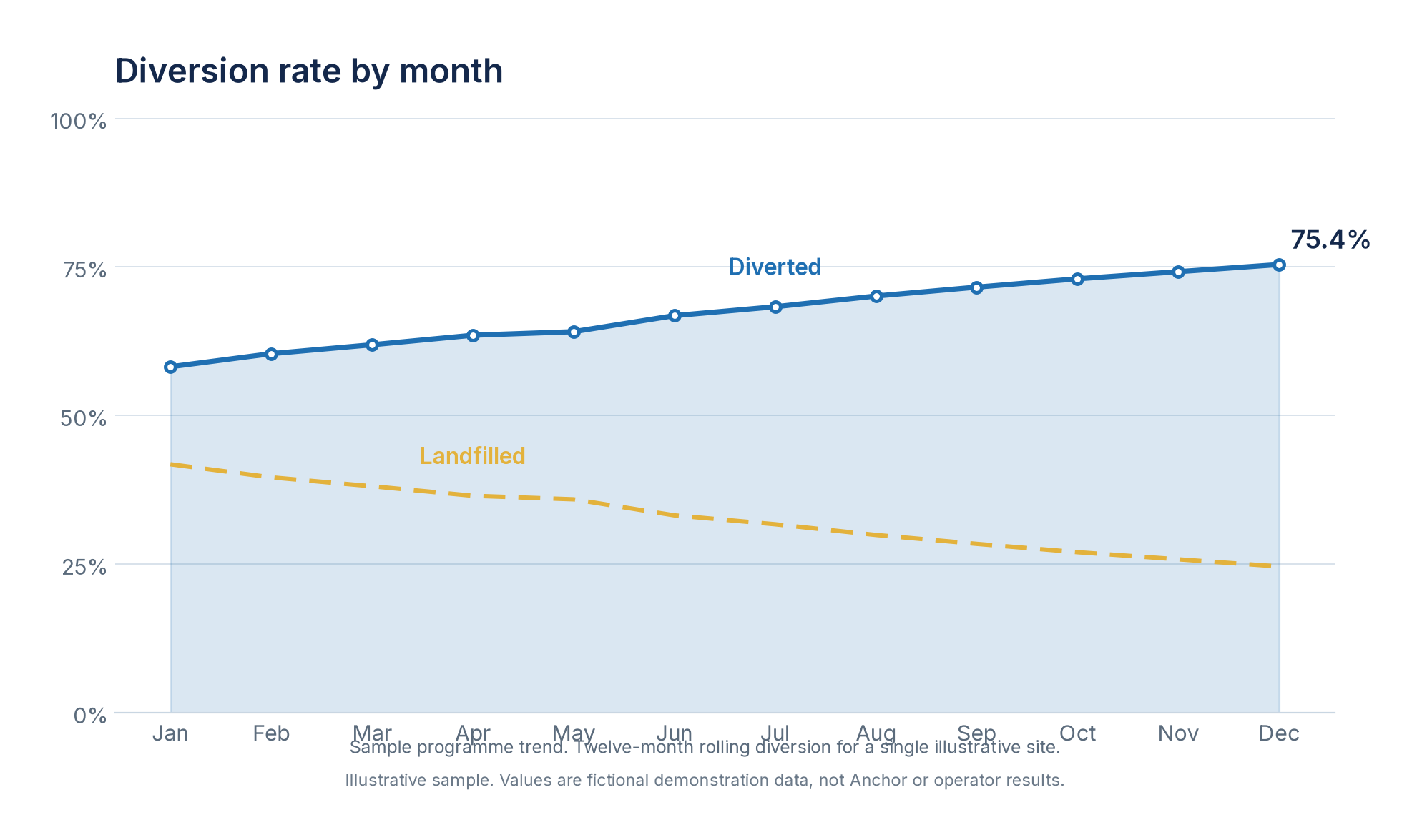
Recycling, energy recovery and disposal differ.
Recycling is reported as recycling only when the records support that destination. Energy recovery and disposal are recorded as their own outcomes, not as interchangeable recycling claims.
Your reporting method determines whether and how each category is counted in a diversion calculation. The report identifies the selected boundary, period and weight basis, plus known estimates and gaps.
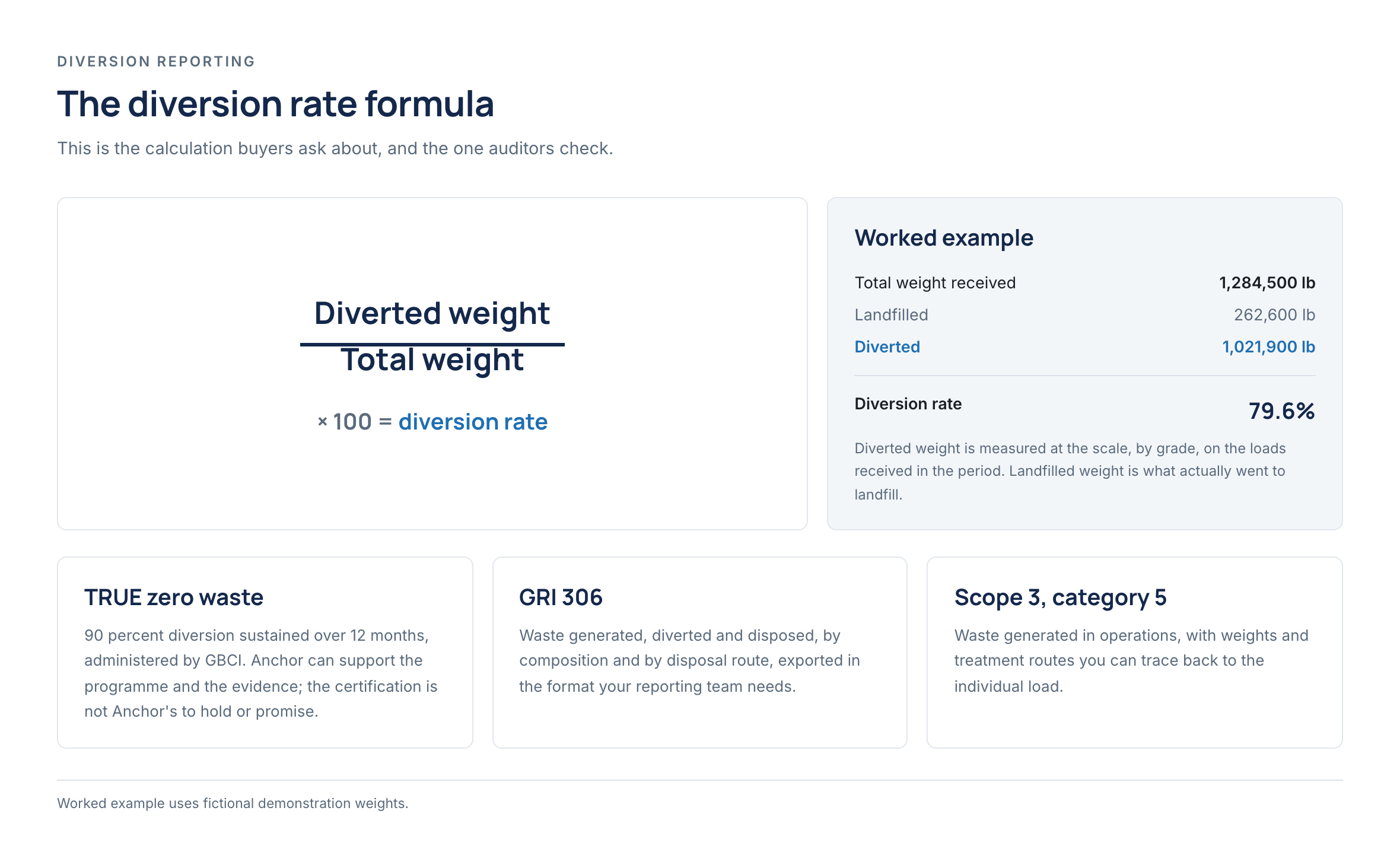
The waste diversion rate formula.
Diversion rate = diverted weight divided by total weight, multiplied by 100. Use the same period, site boundary and weight basis in both parts. Total weight must include the relevant disposal streams. Do not double-count material moved between sites.
An illustrative calculation belongs in a model, not in a claim about Anchor's performance. The resource calculator rejects a zero denominator and diverted weight greater than total weight.

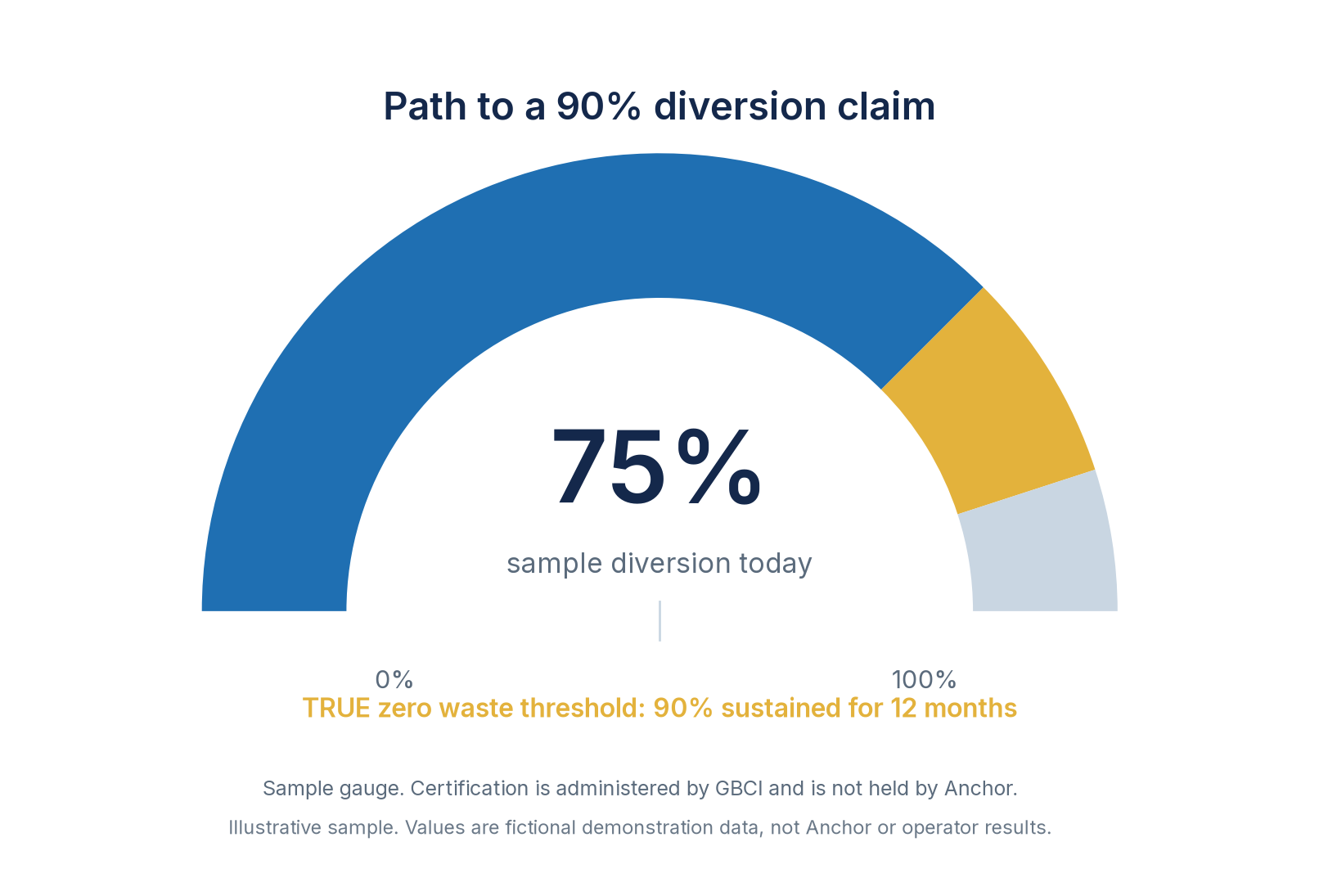
Prepare records for zero waste goals.
TRUE is administered by Green Business Certification Inc. Its eligibility requirements include at least 90 percent diversion from landfill, incineration and waste-to-energy, averaged over the most recent 12 months, plus other minimum requirements and credits. A diversion percentage alone does not qualify a business for TRUE.
Anchor can support preparation with records and program coordination. Your project team should confirm the current rating system and eligibility with the administrator.

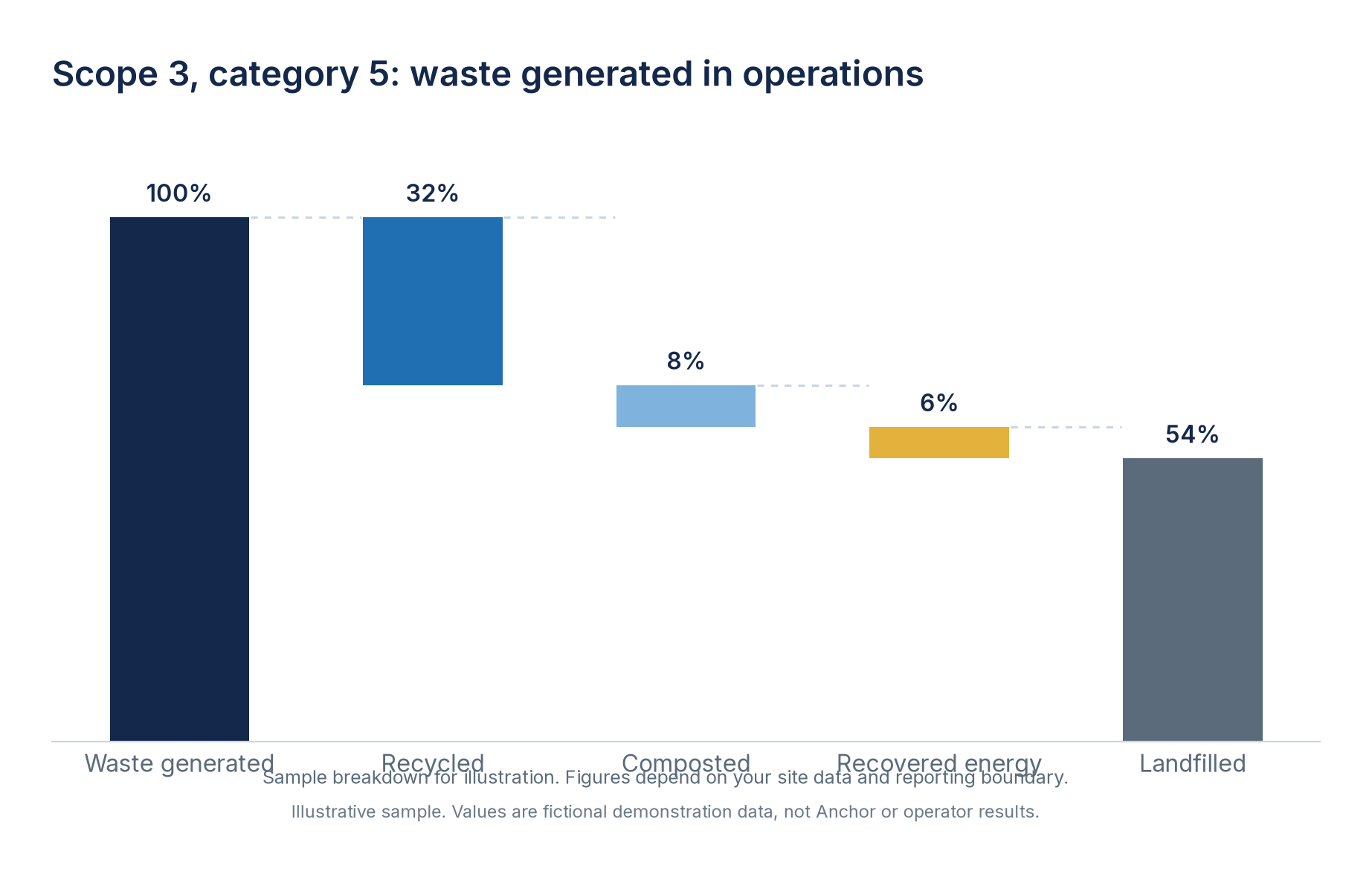
GRI 306 and Scope 3 category 5 data.
Site and material records can support GRI 306 disclosures and Scope 3 category 5 calculations for waste generated in operations. Weight is activity data, not an emissions result. Your reporting method still needs the appropriate treatment information, emissions factors and organizational boundary.
Agreed program reports and year-end diversion summaries can separate measured from estimated values and keep certificate references connected. Your sustainability team controls the final disclosure and methodology.

Records and exceptions remain visible.
Agreed reporting can identify the site, material, service, weight basis, destination classification and relevant processing evidence. Anchor coordinates the records, and independent executing operators provide documentation from their scoped service.
An exception is logged with its evidence and any required approval. The agreed resolution remains connected to the affected record under the program agreement.
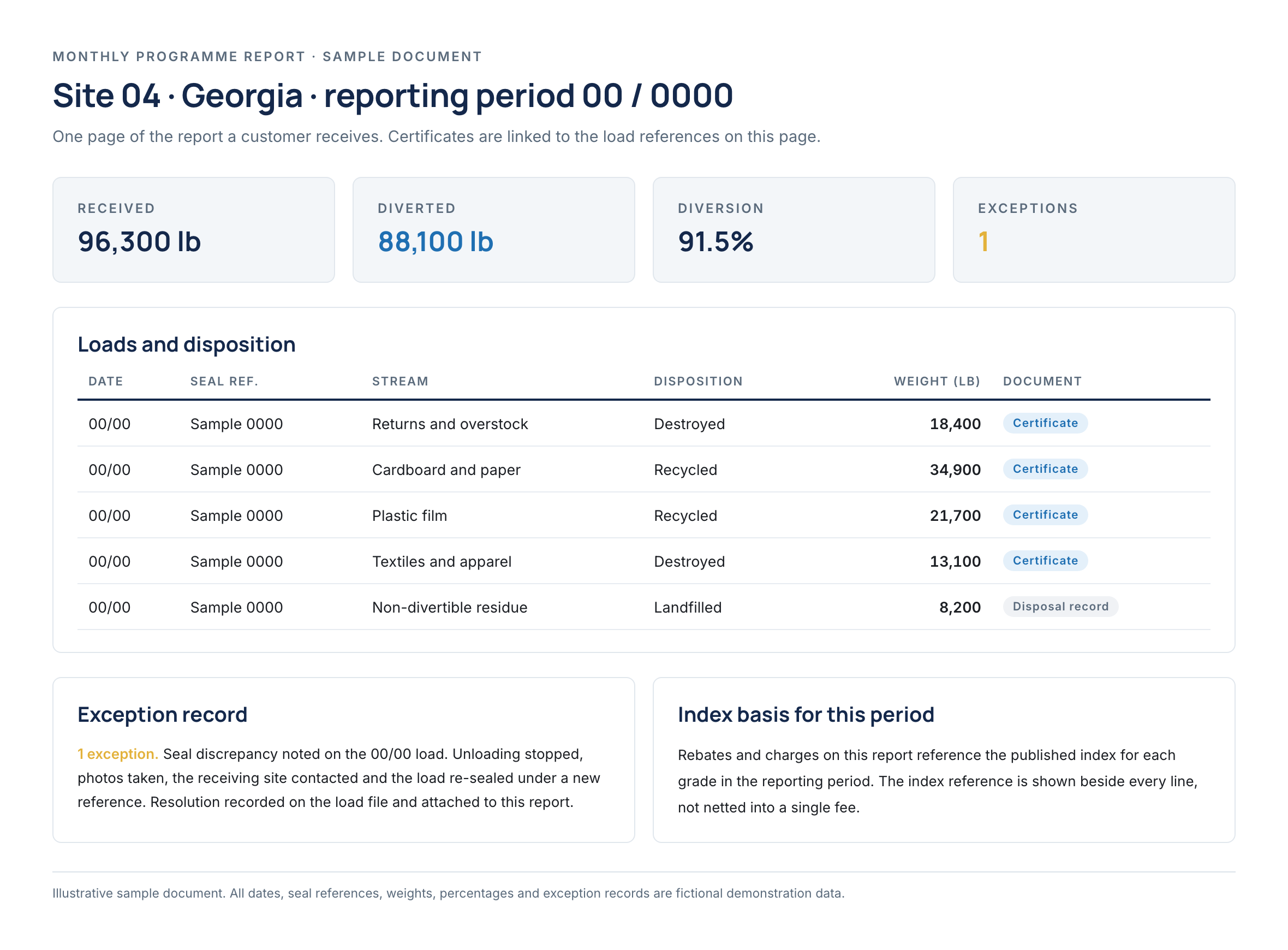
Monthly program report, illustrative sample
One site. Connected records.
Sample Site 04, Georgia. Reporting period 00 / 0000. All values and references are fictional.
- Received
- 96,300 lb
- Diverted
- 88,100 lb
- Diversion
- 91.5%
- Exceptions
- 1
Material flow by weight
Illustrative distribution, not Anchor or operator performance.
Destroyed · Certificate · Sample 0000 · 00/00
Recycled · Certificate · Sample 0000 · 00/00
Recycled · Certificate · Sample 0000 · 00/00
Destroyed · Certificate · Sample 0000 · 00/00
Landfilled · Disposal record · Sample 0000 · 00/00
Exception record
1 fictional exception. A seal discrepancy is noted on the 00/00 load. Unloading stops, photos are taken and the receiving site is contacted. The sample shows resealing under a new reference, with the resolution attached to the load file and report.
Index basis for this period
Eligible rebates and charges reference the published index for each grade and reporting period. The index reference belongs beside each line, not hidden in a single fee. Final terms are agreed in the program.
Illustrative sample. Values are fictional demonstration data, not Anchor or operator results. All dates, seal references, weights, percentages and exceptions are fictional. Unit conversions use 1 lb = 0.45359237 kg.
View the complete original artwork

Illustrative sample. All data fictional. Download PDF
Waste diversion rate calculator
Use the same reporting period and boundary. Values are pounds.
Diversion = diverted weight / total weight × 100.
Resources for your next decision.
Scope 3 category 5: how to report waste generated in operations
Learn how to build a defensible Scope 3 Category 5 waste inventory, connect records to factors, and prepare multi-site reporting with confidence.
Read the guide ReportingZero waste to landfill certification: what TRUE requires and how to prepare
Prepare multi-site operations for TRUE zero waste certification with clear diversion, records, Scope 3 context, and practical next steps to act now.
Read the guideClear answers
What you should know.
Can Anchor certify my business as zero waste?
No. Anchor supports program preparation and documentation. Certification decisions belong to the relevant independent administrator.
Is diversion the same as recycling?
No. The accepted diversion categories depend on the reporting framework. Reuse, composting and other destinations may be counted differently. Define the method before calculating a rate.
Does a recycling certificate calculate Scope 3 emissions?
No. A certificate may support activity data. Emissions calculations require a defined method, treatment information and suitable emissions factors.